



Project Overview
The Online Solar Challenge is open to international submissions, and provides the most accessible approach for any student team anywhere, to participate in a KidWind Challenge. Student teams in grades 4th-12th participate in age-level divisions to create a solar powered project on the theme Solar Home. A solar home is a type of structure that considers the environment, the inhabitants, and its functional and aesthetic design. We encourage teams to think creatively and even fantastically about their solar homes. The environment can range from outer space to the arctic, and the inhabitants can be anything from people to butterflies! You can check for confirmation that you submitted your project by looking at the View Projects section of the Online Solar Challenge page.
There are two Solar KidWind Challenge divisions: Solar Home and Solar Smart Home. Students in 4th-12th grade can participate in the Solar Home Division, and only students in 6th-12th grade can participate in the Solar Smart Home division. To upload a solar home, an adult coach is required to provide contact information. A coach can be a parent, educator, or mentor. A coach may supervise multiple teams. Once uploaded, the solar home project may be displayed within the Solar Challenge Gallery on the KidWind website.
Submissions will be judged by the KidWind team and winners will be selected on a quarterly basis. Winners receive prizes and are invited to participate in the World KidWind Challenge, a large and prestigious in-person event, hosted at a conference center in a different state every year.
Projects will be grouped for evaluation based on the following time frames:
- Projects submitted by November 1st for Quarter 1
- Projects submitted by February 1st for Quarter 2
- Projects submitted by April 1st for Quarter 3
- Projects submitted by August 1st for Quarter 4
Judging Rubric
- 50% Resourcefulness, Creative Concept, Thoughtful Design, Skill and Aesthetics, World Connections
- 50% Functionality, Research, Knowledge, Teamwork, Communication
If your team is chosen as a winner, a KidWind staff member will contact the coach. Winners selected from Quarters 1-3 (August 1st through April 1st) will be invited to a World KidWind Challenge in May of each year.
How Do I Participate?
Download & read the detailed rules.
Fill out and upload the appropriate Solar Home requirements:
- Solar Panel Schematic(s): In the solar panel schematic, include each solar powered circuit’s configuration (parallel/series), and a label to what the terminals connect to. Label each panel’s rated voltage and current, the length, width, and area of each solar panel, and each configurations voltage/current/wattage total. This Schematic is different from the wiring diagram because it only includes the solar panel arrangement, not the rest of the circuit. For example, if the team has up to three circuits that are powered by solar, they will need to provide three solar panel schematics. Find examples here.
- Wiring Diagram(s): Each circuit requires a separate wiring diagram. Teams must provide a wiring diagram for no more than three circuits. Each wiring diagram must include a symbols key. The wiring diagram should have the symbols labeled for all the electrical parts of a circuit, and every emergency switch clearly labeled as such in the diagram. If using power storage, teams will label how the solar panels are charging the power storage and how the storage is powering the loads on the device. Solar Home Elementary 4th-5th Division can create a hand drawn wiring diagram. Find examples here.
- Programming code: For Solar Smart Home Division only. Provide the programming code used to program the microcontroller.
- Materials List: The material list is a document for teams to record all materials used in the solar home, how the materials were used, if the materials are recycled, found, or new, and the costs of materials. If the material is a 3D printed part, teams must explain if the file was found, modified, or created. Budget should identify 3D printed parts as new material cost. Material cost = filament price/filament weight x model weight. See Materials in Requirements for more information.
Please note: The more data you share in the project submission form, the better our judges will be able to evaluate and score your Solar Home. Teams that submit details in most or all of the submission form fields often score higher.
Standards Addressed
The Solar Challenge is a STEAM activity and connects to and is judged by STEAM standards.Next Generation Science Standards (NGSS), International Society for Technology Education Standards (ISTE), National Core Arts Standards (NCAS).
Submit Your Project
Project Submissions

NMHSOLAR
Northfield Mount Hermon · Pete Sniffen
A green solution
Solar Home
Project Overview
Half enclosed green house with a grey water system. The green house was modeled to fit the needs to an average resident in Gill. A place to grow food and interact.
Video of Device Running

McDuck Manor
Lanier High · Proffitt/Robinson
McDuck Manor
Solar Smart Home
Project Overview
The McDuck Manor powers the urban metropolis known as Duckburg, fueling every need and desire of the citizens. Since Mr. McDuck owns the panels, the amount of money located in his bin is constantly growing without him lifting a finger. With everyone relying on his clean, reliable power.
Video of Device Running

The ViBRAINiums
Lanier High · Popa/Robinson
The ViBRAINiums
Solar Smart Home
Project Overview
Our group is called the ViBRAINiums and we are making a solar-powered home themed and based on the hit MCU cinematic movies, Black Panther and Black Panther: Wakanda Forever. Vibranium is a powerful, high-energy conducting ore that will be represented by the constantly-scanning solar panel for the greatest amount of light energy received to power our solar home.
Energy Optix
Lanier High · Hallford/Robinson
Sentinel
Solar Smart Home
Project Overview
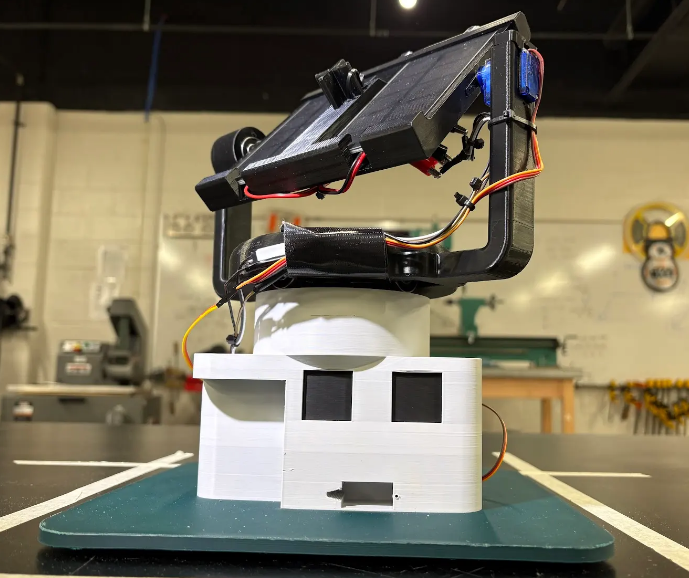
The Sentinel-01 is a fully custom, 3D-printed solar house designed and built by Energy Optix, a five-person team from Lanier High School in Sugar Hill, Georgia. It features a dual-axis solar tracking system controlled by a BBC micro:bit, which reads voltage from two solar panels in series to scan and find the optimal light-facing position. Compact enough to fit within a one-foot cube, the Sentinel-01 demonstrates how intelligent, active solar tracking can maximize renewable energy harvest in a small, self-sufficient home.
Video of Device Running

Solara Drift
Lanier High · Hallford/Robinson
Solara Drift
Solar Smart Home
Project Overview
This project has a cyberpunk theme, containing motorized solar panels to ensure maximum energy efficiency. Voltage input from the solar panels allow it to automatically position itself using servos to face the strongest source of light to ensure the best utilization of the sun's energy. This project has a futuristic look and feel while creating an efficient source of renewable energy.

Sun-eaters
Lanier High · Proffitt/Robinson
Hallford's Heroes
Solar Smart Home
Project Overview
Deep in the forest, the Sun-eaters' abandoned power plant brings sanctuary to plants and animal life with structure, stability, and power produced from its Solar-Flower. The Sun-eaters’ abandoned power plant’s original purpose in the world was to provide power to people, but now that it’s rundown and abandoned by its creators, it uses its power of solar energy to give the plants and animals it hosts the security they need to survive. The design of the power plant was made to fit in with its surroundings and with the moss and scattered rocks from years of abandonment it has become one with its forested surroundings. The loss of habitats and deforestation is a real problem for animals and plants alike.
Video of Device Running

Cartman Club
Lanier High · Robinson
Cartman Club
Solar Smart Home
Project Overview
We were tasked with building a structure that consisted of servos and solar panels. Our goal was to combine engineering and computer science concepts to create a design that maximized efficiency from the solar panels we were given. The main challenge of the project was making a design that allowed the solar panels to function while the sun changed locations.
Video of Device Running

The Smurfs
Lanier High · Popa/Robinson
The Smurfs
Solar Smart Home
Project Overview
Project Overload is an engaging group activity that helps students understand circuits and solar panel technology. It also connects to concepts like the flow of electrons, linking ideas from chemistry. Through this project, students can apply their knowledge to real-world situations.
Video of Device Running

Solar Soldiers
Solar Soldiers · Hallford/ Robinson
Solar Soldiers
Solar Smart Home
Project Overview
The Sol Castle is a solar-powered building designed to support sustainable energy needs in Sugar Hill. The project utilizes geometry, circuit design, and coding to track sunlight, maximize power output, and manage energy efficiently. The design demonstrates how renewable energy systems can provide reliable electricity through the use of solar panels.
Video of Device Running

Solar Savvy
Lanier HS · Proffitt/Robinson
Solar Savvy
Solar Smart Home
Project Overview
The solar project includes servos to move solar panels to a position with the best sunlight. To move the servos, engineers are required to design, wire and construct the panel holders to fit onto the power plant base. The computer scientists are required to write code to move the panels, which works accordingly with the final design produced by the group.
Video of Device Running

Solar KREW
MOT Charter High School · Brian Hurd
MOT Butterfly Utopia
Solar Home
Project Overview
This project was completed to allow students at our school to see butterflies either in passing, or through scheduled visits. The idea for this project came from our school’s Green Club which all three of our team members are a proud part of. This project demonstrates one of a plethora of uses for clean energy.
Video of Device Running
Robotic Raiders
North Cross School · Mr. DeMoss
The Breezy Bee, Solar Home for Bees
Solar Home
Project Overview
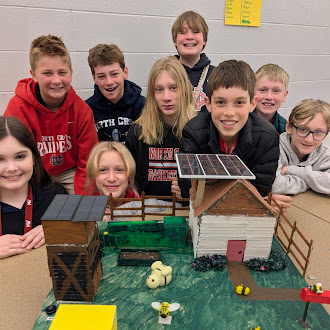
The solar home is called the Breezy Bee, With honeybees in almost a free fall decline we wanted to find a way to bolster hive production and provide a helpful hand to level off and eventually invert the decline. We built the Breezy Bee which vents our hive using a servo motor. We also built the Bee Booster package which waters gardens and provides a clean water source for bees.
Video of Device Running

Einstein Extraordinaires
Haine Elementary School · Jeremiah Friday and Linda Weismann
The Two Time Laboratory
Solar Home
Project Overview
The Two Time Laboratory was created to show that environmental science can help people by reducing the amount of non-renewable resources used. It features a main house with a lab, a shed for gardening, and a toxic waste filtration plant powered by solar power. The laboratory has a double function, as it also serves as their home, which is why its name is Two Time Laboratory!
Video of Device Running
Pirates of Pitch Goes Solar
DeLand Weldon CUSD 57 · Janelle Harper
Beach House
Solar Home
Project Overview
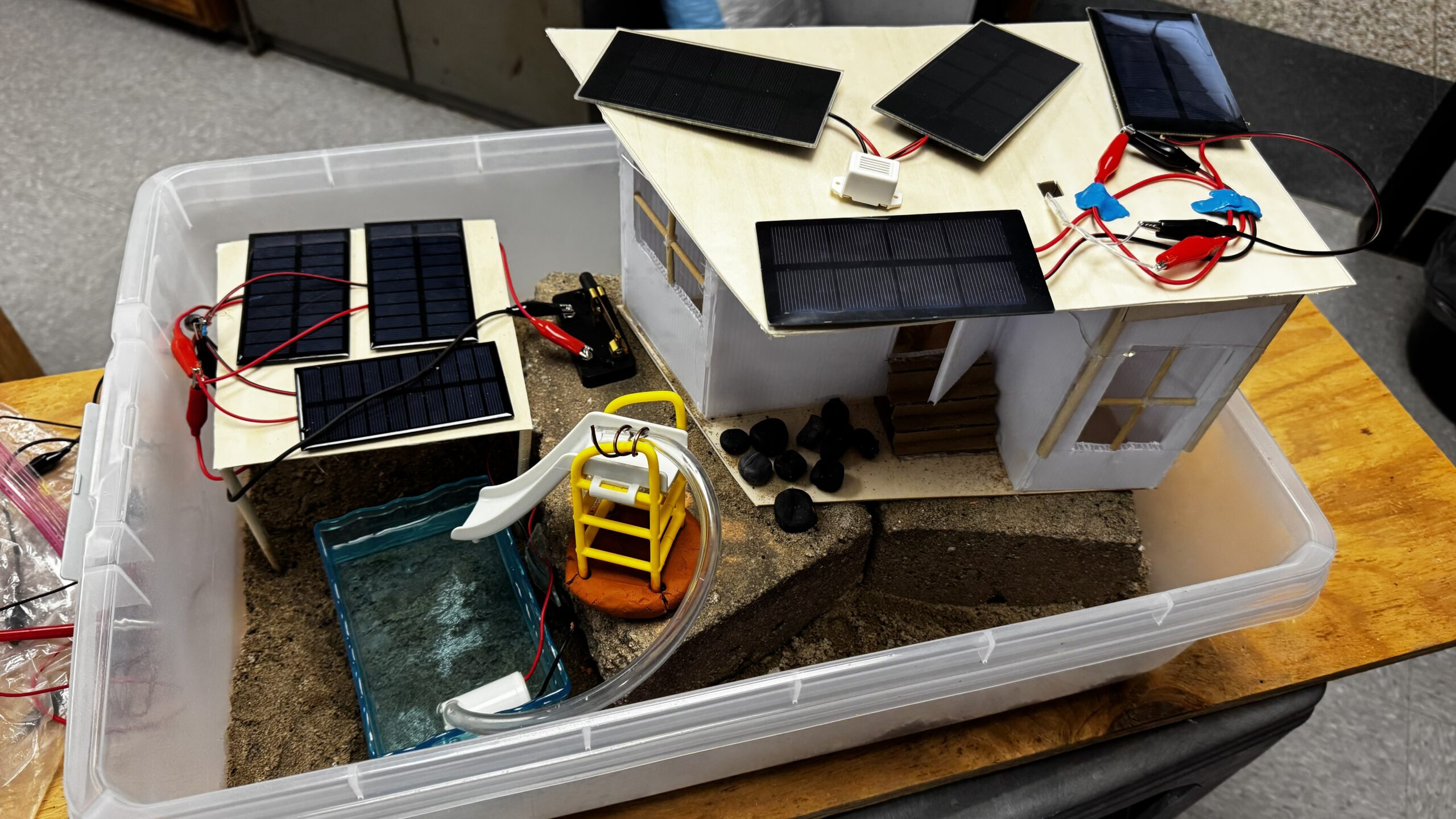
We chose a beach house design because we thought it would be fun to create, we had the supplies needed to build it available and incorporating renewable energy into a home along the beach would have the least amount of negative impact on the local ecology and environment.
Video of Device Running

Watts Up!
Londonderry · Brian
Solar greenhouse
Solar Smart Home
Project Overview
Our project is a solar-powered smart greenhouse. The greenhouse is controlled by an Arduino, powered by solar-charged nickel metal-hydride batteries, which monitors its temperature and humidity. With its knowledge of humidity and temperature, it can raise and lower the roof and water the plants to care for them.
Video of Device Running
Heart and Sol
Chesapeake Math and IT Academy South · Christopher Roorda
Solarville
Solar Smart Home
Project Overview
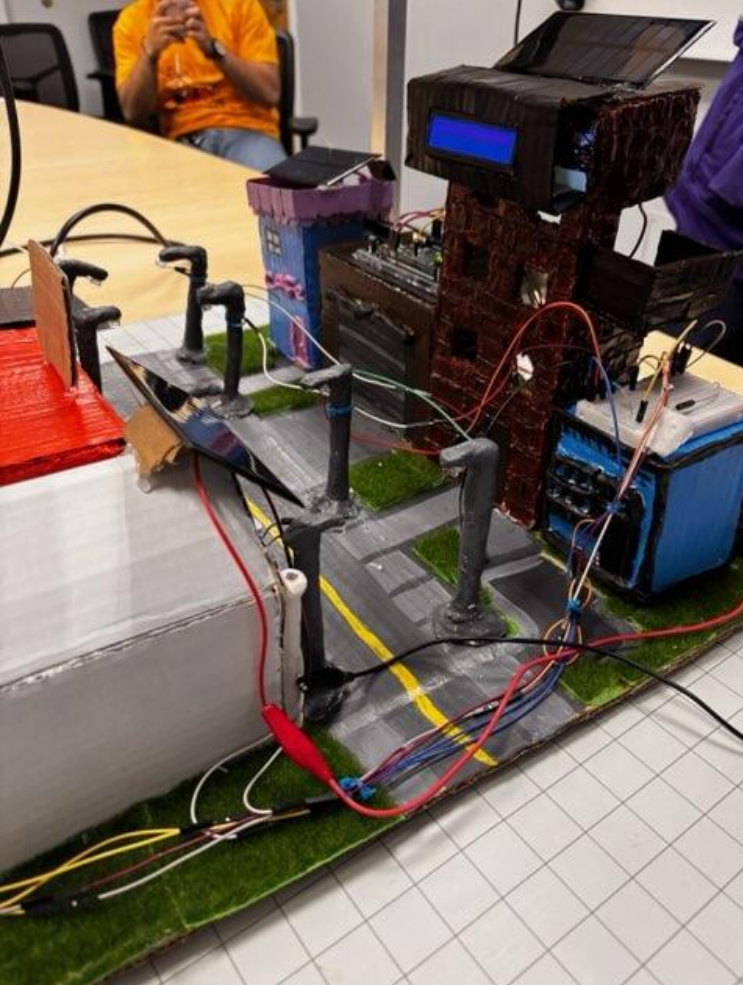
Our project is a city, powered entirely by solar panels that sit on top of 2 different buildings. The main solar structure is the apartment that features an LCD screen. The city also consists of lampposts that use LED lights to imitate real street lights.
Video of Device Running
Wildflowerz
SIgnal Knob Middle School · Mrs. Price
Pollinator Palace
Solar Home
Project Overview
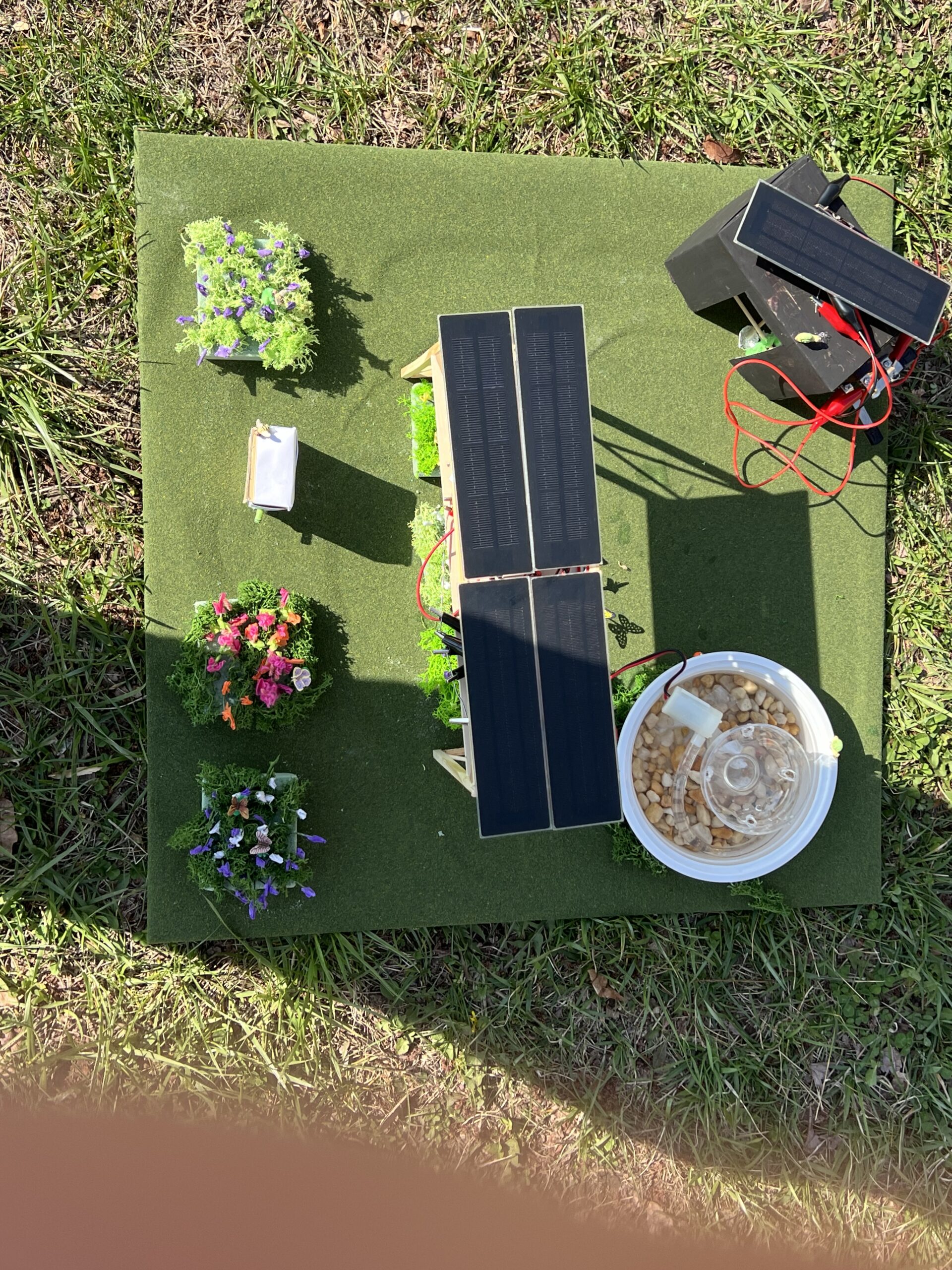
Our Pollinator Palace is designed to be a sanctuary for pollinators especially including butterflies and bees. We used 5 long solar panels to power both an emergency light and a fountain water pump. Overall this garden is a sustainable home for insects of all kinds.